

1.5 Application

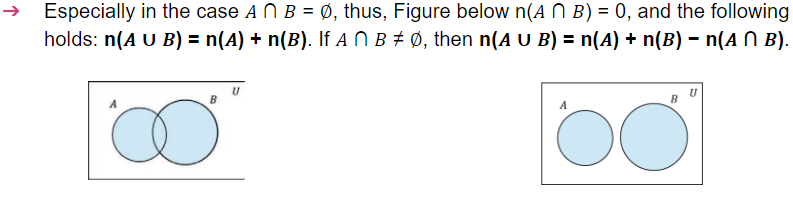
Number of Elements of union of two sets For the two subsets 𝐴 and 𝐵 of a universal set 𝑈, the following formula on the number of elements holds. That is

Let 𝐴 and 𝐵 be two finite sets such that n(𝐴) = 15, n(𝐵) = 18, and n(𝐴 ∪ 𝐵) = 22; then find n(𝐴 ∩ 𝐵).

Given Required
n(A) = 15 n(A ∩ B) = ?
n(B) = 18
n(A ∪ B) = 22
We know that n(A ∪ B) = n(A) + n(B) - n(A ∩ B)
From this n(A ∩ B) = n(A) + n(B) - n(A ∪ B) = 15 + 18 - 22 = 33 - 22 = 11
So n(A ∩ B) = 11
1. Let 𝐴 and 𝐵 be two finite sets such that n(𝐴) = 34, n(𝐵) = 46 and n(𝐴 ∪ 𝐵) = 70. Then, find n(𝐴 ∩ 𝐵).
Given Required
n(A) = 34 number of people drinks both n(A ∩ B) = ?
n(B) = 46
n(A ∪ B) = 70
We know that n(A ∪ B) = n(A) + n(B) - n(A ∩ B)
From this n(A ∩ B) = n(A) + n(B) - n(A ∪ B) = 34 + 46 - 70 = 80 - 70 = 10
So n(A ∩ B) = 10
2.There are 60 people attending a meeting.42 of them drink tea and 27 drink coffee. If every person in the meeting drinks at least one of the two drinks, find the number of people who drink both tea and coffee. (Hint: Use a Venn diagram).
Given Required
Let us say number of people drinks both n(A ∩ B) = ?
n(A) = number of people that drink tea = 42
n(B) = number of people that drink coffee = 27
n(A ∪ B) = 60
We know that n(A ∪ B) = n(A) + n(B) - n(A ∩ B)
From this n(A ∩ B) = n(A) + n(B) - n(A ∪ B) = 42 + 27 - 60 = 69 - 60 = 9
So n(A ∩ B) = 9 ,........number of people who drinks both coffee and tea