

1.3 The Notion of Sets

Empty Set
A set which does not contain any element is called an empty set or void set or null set.
The empty set is denoted mathematically by the symbol { } or Ø.

Let set 𝐴 = {𝑥 | 4 < 𝑥 < 5, 𝑥 ∈ ℕ}. Then, 𝐴 is an empty set, because there is no natural number between numbers 4 and 5.

Definition 1.1 A set which consists of a definite number of elements is called a finite set. A set which is not finite is called an infinite set.
If a set A is finite,then the number of elements of set 𝐴 is denoted by n(A).
identify the following sets as a finite set or an infinite set.
a. The set of natural numbers up to 100

Finite set
b. The set of female students in Ethiopia in 2017.
Finite set
c. The set of natural numbers.
Infinite set

1. Identify empty set from the list below.
a. 𝐴 = {𝑥 | 𝑥 ∈ ℕ and 5 < 𝑥 < 6}
Ø
b. 𝐵 = {0}
n(B) = 1 , not empty set because it has elements
c. C is the set of odd natural numbers divisible by 2.
Ø,no odd number can be divisible by 2
C = {1,3,5,7,9 11,13 15,........}
d. 𝐷 = { }
{ } = Ø
2. Sort the following sets as finite or infinite sets.
a. The set of all integers
Infinite set Z = { ……, -3,-2,-1, 0 , 1,2,3,.....
b. The set of days in a week
Finite set = {monday ,thursday ,......, sunday}
c. 𝐴 = {𝑥 ∶ 𝑥 is a multiple of 5}
Infinite set Ex A = { ……, -15,-10,-5, 0 ,5,10,15,....}
d. 𝐵 = {𝑥 ∶ 𝑥 ∈ 𝑍, 𝑥 < −1}
Infinite set B = {.......,-5,-4,-3,-2}
e. 𝐷 = {𝑥 ∶ 𝑥 is a prime number}
Infinite set D = {2,3,5,7,11,13,.......}

- Two sets 𝐴 and 𝐵 are said to be equal if and only if they have exactly the same or identical elements.
- Mathematically, it is denoted as 𝐴 = 𝐵. If they don’t have the same elements the sets said to be unequal sets. It donated as A ≠ B.
a. A = {1, 2, 3} and B = {3, 2, 1}
n(A) = n(B) and A and B are same type
So A = B or A and B are equal sets
b. A= {a,b,c,d,e} and B= {5, a,d, e,13}
n(A) = n(B) = 5 but A and B are not same type
So A ≠ B or A and B are not equal sets
Two sets 𝐴 and 𝐵 are said to be equivalent if there is a one-to-one correspondence between the two sets. This is written mathematically as 𝐴 ↔ 𝐵 (or 𝐴~𝐵).

-
Two finite sets 𝐴 and 𝐵 are equivalent, if and only if they have equal number of elements and we write mathematically this as n(A) = n(B).
Consider two sets 𝐴 = {a, b, c, d} and 𝐵 = {Abdi, Bontu, Girma, Blen}.
n(A) = n(B) = 4
So it A and B are equivalent sets A ~ B
Note :- every equal sets are equivalent sets
A universal set (usually denoted by U) is a set which has elements of all the related sets, without any repetition of elements.
Find the universal set for the following sets: A = {..., -3, -2, -1} and B = {0, 1, 2, 3, ...}
A = {..., -3, -2, -1} → -ve integer
B = {0, 1, 2, 3, ...} → +ve integer and zero
A ∪ B = {.....,-3,-2,-1,0,1,2,3,....}
Z = {.....,-3,-2,-1,0,1,2,3,....}
Set A is said to be a subset of set B if every element of 𝐴 is also an element of 𝐵. The figure below shows this relationship between the sets. Mathematically, we write this as 𝑨 ⊆ 𝑩. If set 𝐴 is not a subset of set 𝐵, then it is written as A ⊈ B
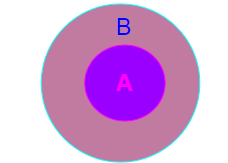
A = {a,b,c}
B = {a,b,c,f}
A⊆ B but B ⊈ A
-
For n, element the total number of subset = 2n
Let 𝐴 = {1, 2, 3} and 𝐵 = {1, 2, 3, 4} is A is a subset of B? find all subsets of the set. How many subsets does set A have?
A = {1, 2, 3}
B= {1, 2, 3, 4}
A⊆ B
n(A) = 3 total number of subset = 2³ = 8
A = {1,2,3} = { } {1} (2} {3} {1,2} {1,3} {2,3} {1,2,3}
{ } ⊆ A , {1} ⊆ A, {2} ⊆ A, {3} ⊆ A, {1,2} ⊆ A , {1,3} ⊆ A , {2,3} ⊆ A, {1,2,3} ⊆ A
i) Any set is a subset of itself.
ii) Empty set is a subset of every set.
iii) If set A is finite with n elements, then the number of subsets of set A is 2n .

If 𝐴 ⊆ 𝐵 and 𝐴 ≠ 𝐵, then 𝐴 is called the proper subset of set 𝐵 and it can be written as 𝐴 ⊂ 𝐵.
Given that sets A = {1, 2, 3} and B = {1, 2, 3, 4}. Is set A a proper subset of B? How many proper subsets does set A have?
A ⊂ B
A = {1, 2, 3}
{ } ⊂ A, {1} ⊂ A, {2} ⊂ A, {3} ⊂ A, {1,2} ⊂ A, {1,3} ⊂ A, {2,3} ⊂ A, but {1,2,3} ⊄ A
n(A) = 3 total number of proper set = 2n - 1
i) For any set A, A is not a proper subset of itself.
ii) The number of proper subsets of set A is 2n - 1.
iii) Empty set is the proper subset of any other set.
iv) If set 𝐴 is subset of set B (A ⊆ B), conversely, B is superset o of A written as B ⊃ A
1. Identify equal sets, equivalent sets or which are neither equal nor equivalent.
a. 𝐴 = {1, 2, 3} and 𝐵 = {4, 5}
n(A) = 3 and n(B) = 2 so the given two sets are neither equal nor equivalent.
b. 𝐶 = {𝑞, 𝑠, 𝑚} and 𝐷 = {6, 9, 12}
n(C) = 3 and n(D) = 3 but they are not same type so the two sets are equivalent set.
c. 𝐸 = {3, 7, 9, 11} and 𝐹 = {3, 9, 7, 11}
n(E) = 4 and n(F) = 4 and they are same type so the two sets are equal set.
d. 𝐺 = {𝐼,𝐽,𝐾, 𝐿} and 𝐻 = {𝐽,𝐾,𝐼, 𝐿}
n(G) = 4 and n(H) = 4 and they are same type so the two sets are equal set.
e. 𝐼 = {𝑥 | 𝑥 ∈ 𝕎, 𝑥 < 5} and 𝐽 = {𝑥 | 𝑥 ∈ ℕ, 𝑥 ≤ 5}
I = {0,1,2,3,4} J= {1,2,3,4,5} n(I)= 5 and n(J) = 5 but they are not same type so the two sets are equivalent set.
f. 𝐾 = {𝑥 | 𝑥 is a multiple of 30} and 𝐿 = {𝑥 | 𝑥 is a factor of 10}
K = {30,60,90,...} L= {1,2,5,10} n(K) ≠ n(L) neither equal nor equivalent set.
2. List all the subsets of set H = {1, 3, 5}. How many subsets and how many proper subsets does it have?
H = {1,3,5}
n (H) = 3
Number of subset of H = 2³ = 8
Number of proper subset of H = 2³ - 1 = 8 - 1 = 7
Subset of H = {1,3,5} = { },{1}, {3}, {5}, {1,3},{1,5},{3,5},{1,3,5}
Proper subset H = {1,3,5} = { },{1}, {3}, {5}, {1,3},{1,5},{3,5}
3. Determine whether the following statements are true or false.
a. {𝑎, 𝑏} ⊄ {𝑏, 𝑐, 𝑎}
{𝑎, 𝑏} ⊄ {𝑏, 𝑐, 𝑎} ……… False
b. {𝑎, 𝑒} ⊆ {𝑥 | 𝑥 is a vowel in the English alphabet}
{𝑎, 𝑒} ⊆ {a,e,i,o,u}..........True
c. {𝑎} ⊂ { 𝑎, 𝑏, 𝑐 }
{𝑎} ⊂ { 𝑎, 𝑏, 𝑐 }...........True
4. Express the relationship of the following sets, using the symbols ⊂, ⊃, or =
a. 𝐴 = {1, 2, 5, 10} and 𝐵 = {1, 2, 4, 5, 10, 20}
A ⊂ B
b. 𝐶 = {𝑥 |𝑥 is natural number less than 10} and 𝐷 = {1, 2, 4, 8}
C = {1,2,3,4,5,6,7,8,9}
D = {1,2,4,8}
C ⊃ D
c. 𝐸 = {1, 2} and 𝐹 = {𝑥 | 0 < 𝑥 < 3, 𝑥 ∈ ℤ}
E = {1,2}, F={1,2}
E = F
5. Consider sets A = {2, 4, 6}, B = {1, 3 7, 9, 11} and C = {4, 8, 11}, then
a. Find the universal set
U = {1,2,3,4,6,7,8,9,11}
b. Relate sets A, B, C and 𝑈 using subset.
A ⊆ U
B ⊆ U
C ⊆ U