

1.4 Operations on Sets

There are several ways to create new sets from sets that have already been defined. Such process of forming new set is called set operation.
The four most important set operations namely


In set theory, the union of two sets is the set of all elements that are in either set, while the intersection of two sets is the set of all elements that are in both sets

- A Venn diagram is a schematic or pictorial representation of the sets involved in the discussion.
-
Usually sets are represented as interlocking circles, each of which is enclosed in a rectangle, which represents the universal set.
For example
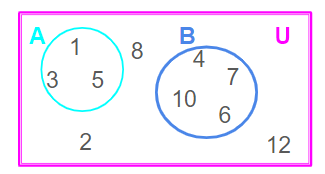

- The union of two sets 𝐴 and 𝐵, which is denoted by 𝑨 ∪ 𝑩, is the set of all elements that are either in set 𝐴 or in set 𝐵 (or in both sets).
- We write this mathematically as 𝐴 ∪ 𝐵 = {𝑥 | 𝑥 ∈ 𝐴 or 𝑥 ∈ 𝐵}


-
The union of two sets 𝐴 and 𝐵, which is denoted by 𝑨 ∪ 𝑩, is the set of all elements that are either in set 𝐴 or in set 𝐵 (or in both sets).
-
We write this mathematically as 𝐴 ∪ 𝐵 = {𝑥 | 𝑥 ∈ 𝐴 or 𝑥 ∈ 𝐵}


Two sets 𝐴 and 𝐵 are disjoint if 𝐴 ∩ 𝐵 = ∅


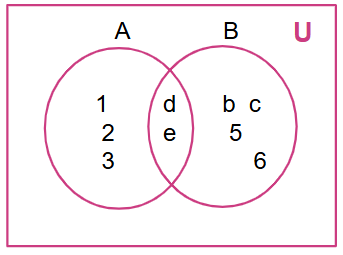
Let A = {1,2,3,d,e} and B = {b,c,d,e,5,6} be sets. Draw the Venn diagram and find A ∪ B and A ∩ B.

A ∪ B = {1,2,3,5,6,b,c,d,e }
A ∩ B = { d,e }

Let A = {6,12,18,24,30,…} and B = {7,14,21,28,35,…} be sets. Then, find A ∪ B and A ∩ B.
A ∪ B = {6,12,18,24,30,36,42,....}..............multiple of 6
A ∩ B = { 7,14,21,28,35,42,49,.... }............ multiple of 7
A ∪ B = {6,7,12,14,18,21,24,28,30,35,36,42,48,49,.....}
A ∩ B = { 42,84,....}
i) Law of ∅ and 𝑈: ∅ ∩ A = ∅, 𝑈 ∩ A = A.
ii) Commutative law: A ∩ B = B ∩ A. and A ∪ B =B ∪ A
iii) Associative Law: (A ∩ B) ∩ C = A ∩ (B ∩ C) and (A∪B)∪C = A∪(B∪C)

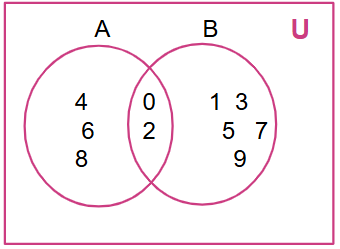
1. Let A = {0,2,4,6,8} and B = {0,1,2,3,5,7,9}. Draw the Venn Diagram and find A ∪ B and A ∩ B.
A ∪ B = {0,1,2,3,4,5,6,7,8,9 }
A ∩ B = { 0,2 }
2. Let A be the set of positive odd integers less than 10 and B is the set of positive multiples of 5 less than or equal to 20. Find
a) A ∪ B
A = {1,3,5,7,9} …… Positive odd integer less than 10
B = {5,10,15,20} …… positive multiple of 5 less than or equal to 20
A ∪ B = {1,3,5,7,9,10,15,20}
b) A ∩ B
A = {1,3,5,7,9} …… Positive odd integer less than 10
B = {5,10,15,20} …… positive multiple of 5 less than or equal to 20
A∩B = {5}
3. Let C = {𝑥 | 𝑥 is a factors of 20}, D = {𝑦 | 𝑦 is a factor of 12}. Find
a) C ∪ D
C = {1,2,4,5,10,20} ……factor of 20
B = {1,2,3,4,6,12} ……factor of 12
C ∪ D = {1,2,3,4,5,6,10,12,20}
b) C ∩ D.
C = {1,2,4,5,10,20} ……factor of 20
D = {1,2,3,4,6,12} ……factor of 12
C ∩ D = {1,2,4}
Let 𝐴 be a subset of a universal set 𝑈. The absolute complement (or simply complement) of 𝐴, which is denoted by 𝑨′ , is defined as the set of all elements of 𝑈 that are not in 𝐴. We write this mathematically as 𝐴′ = {𝑥: 𝑥 ∈ 𝑈 and 𝑥 ∉ 𝐴}.
a. Let 𝑈 = {11, 12, 13, 14, 15} and 𝐴 = {12, 14}. Then find 𝐴′.
A ⊆ U
A′ = {11,13,15}
Let 𝑈 = {1, 2, 3, … , 10} be a universal set, A = {𝑥 | 𝑥 is a prime number in 𝑈} and B = {𝑥 | 𝑥 is an even integer in 𝑈} be sets.
a. Find A′ and B′
U ={1,2,3,.....,10}
A = prime number in U = {2,3,5,7}
B = even integer number in U = {2,4,6,8,10}
A′ = {1,4,6,8,9,10} , B′ = {1,3,5,7,9}
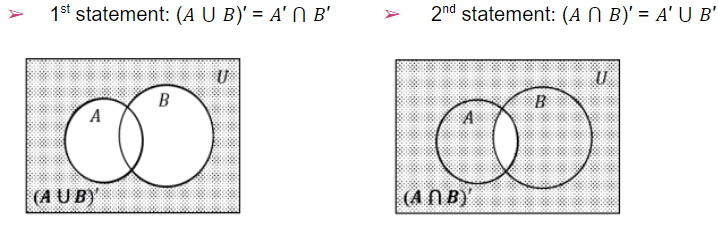
b. Find (A ∪ B)′ and A′ ∩ B′. What do you observe from the answers?
First let us find A ∪ B = {2,3,4,5,6,7,8,10}
(A ∪ B)′ = {1,9}
A′ ∩ B′ = {1,9}
From this we can conclude that (A′ ∩ B′) = A′ ∩ B′

For the complement set of 𝐴 ⋃ 𝐵 and 𝐴 ⋂ 𝐵,

1. If the universal set 𝑈 = {0, 1, 2, 3, 4, 5}, and 𝐴 = {4, 5}, then find 𝐴 ′ .
A′ = {0,1,2,3}
2. Let the universal set 𝑈 = {1, 2, 3, … , 20}, A = {𝑥 |𝑥 is a positive factor of 20} and B = {𝑥 | 𝑥 is an odd integer in 𝑈}. Find A′ , B′ , (A ∪ B)′ and A′ ∩ B′ .
A = positive factor of 20 in U
= {1,2,4,5,10,20}
B = odd integer in U
= {1,3,5,7,9,11,13,15,17,19}
A′ = {3,6,7,8,9,11,12,13,14,15,16,17,18,19}
B′ = {2,4,6,8,10,12,14,16,18,20}
(A ∪ B)′ = A′ ∩ B′ = {6,,12,14,16,18}
3. Let the universal set be 𝑈 = {𝑥 | 𝑥 ∈ ℕ, 𝑥 ≤ 10}. When A = {2, 5, 9}, and B = {1, 5, 6, 8},
find
a) A′ ⋂ B′
U = {1,2,3,....,10}
A = {2,5,9} , B = {1,5,6,8} , A′ = {1,3,4,6,7,8,10} , B′ = {2,3,4,7,9,10}
A′ ⋂ B′ = { 3,4,7,10}
b) A′ ⋃ B′
U = {1,2,3,....,10}
A = {2,5,9} , B = {1,5,6,8} , A′ = {1,3,4,6,7,8,10} , B′ = {2,3,4,7,9,10}
A′ ⋃ B′ = (1,2,3,4,6,7,8,9,10}
The difference between two sets A and B, which is denoted by A − B, is the of all elements in A and not in B; this set is also called the relative complement of A with respect to B. We write this mathematically as A − B = {𝑥 | 𝑥 ∈ A and 𝑥 ∉ B}.

The notation 𝐴 − 𝐵 can also be written as 𝐴\𝐵.
If sets A = {1, 2, 3, a, b} and B = {a, 3, 4}, then find A − B or A\B
A = {1, 2, 3, a, b}
B = {a, 3, 4}, then A − B or A\B = {1,2,b}
B - A or B\A = {4}
Let 𝑈 be a universal set of the set of one-digit numbers, A be the set of even numbers, B be the set of prime numbers less than 10. Find the following:
a. A − B or A\B
Given
U … set of one digit number
= {0,1,2,3,4,5,6,7,8,9}
A … set of even natural number in U
= {2,4,6,8}
B ….set of prime number less than 10
= {2,3,5,7}
A - B = {4,6,8}
b. B − A or B\A
Given
U … set of one digit number
= {0,1,2,3,4,5,6,7,8,9}
A … set of even natural number in U
= {2,4,6,8}
B ….set of prime number less than 10
= {2,3,5,7}
B - A = {3,5,7}
c. A ∪ B
Given
U … set of one digit number
= {0,1,2,3,4,5,6,7,8,9}
A … set of even natural number in U
= {2,4,6,8}
B ….set of prime number less than 10
= {2,3,5,7}
A ∪ B = {2,3,4,5,6,7,8}
d. 𝑈 − (A ∪ B) or 𝑈\(A ∪ B)
Given
U … set of one digit number
= {0,1,2,3,4,5,6,7,8,9}
A … set of even natural number in U
= {2,4,6,8}
B ….set of prime number less than 10
= {2,3,5,7}
𝑈 − (A ∪ B) = {0,1,9}

For the same sets in Example 2, find the following. What can you say from Example 2 a. and b.? What about d. Example 2a?
a. 𝐴′
A′ = {0,1,3,5,7,9}
b. 𝑈 − 𝐴
U - A= {0,1,3,5,7,9} = A′
c. 𝐵′
B′ = {0,1,4,6,8,9}
d. 𝐴 ∩ 𝐵′
A ∩ B′ = {4,6,8}

For any two sets A and B, each of the following holds true.
-
For any two sets A and B, each of the following holds true. (𝐴 ′ )′ = 𝐴
-
𝐴 ′ = 𝑈 − 𝐴
-
𝐴 − 𝐵 = 𝐴 ∩ 𝐵 ′
-
𝐴 ⊆ 𝐵 ⟺ 𝐵 ′ ⊆ 𝐴 ′

From the given Venn diagram, find each of the following:

a. 𝐴 − 𝐵 or 𝐴\𝐵
A = {2,3,5} , B = {1,2,4,8}
U = {1,2,3,4,5,6,7,8}
A - B = {3,5}
b. 𝐵 − 𝐴 or 𝐵\𝐴
A = {2,3,5} , B = {1,2,4,8}
U = {1,2,3,4,5,6,7,8}
B - A = {1,4,8}
c. 𝐴 ∪ 𝐵
A = {2,3,5} , B = {1,2,4,8}
U = {1,2,3,4,5,6,7,8}
A ∪ B = {1,2,3,4,5,8}
d. 𝑈 − (𝐴 ∪ 𝐵) or 𝑈\(𝐴 ∪ 𝐵)
A = {2,3,5} , B = {1,2,4,8}
U = {1,2,3,4,5,6,7,8}
U − (A ∪ B) = {6,7}
Symmetric Difference For two sets A and B, the symmetric difference between these two sets is denoted by A∆B and is defined as: A∆B = (A\B) ∪ (B\A) , which is (A −B) ∪ (B − A) or = (A ∪ B)\(A ∩ B) In the Venn diagram, the shaded part represents A∆B

Consider sets A = {a, b, d, e, f} and B = {b, c, e, g}. Then, find A∆B
A = {a,b,d,e,f} , B = {b,c,e,g}
To determine A∆B first we have to determine A - B and B - A
A - B = {a,d,f}
B - A = {c,g}
A ∆ B = (A − B) ∪ (B − A) = {a,d,f} ∪ {c,g} = {a,c,d,f,g}
Given sets A = {a, b, c} and B = {1, 2, 3}. Then, find A∆B.
A = {a,b,c} , B = {1,2,3}
To determine A∆B first we have to determine A - B and B - A
A - B = {a,b,c}
B - A = {1,2,3}
A ∆ B = (A − B) ∪ (B − A) = {a,b,c} ∪ {1,2,3} = {a,b,c,1,2,3} = A ∪ B
-
If A ∩ B = ∅ then A ∆ B = A ∪ B

1. Given A = {0, 2, 3, 4, 5} and B = {0, 1, 2, 3, 5, 7, 9}. Then, find A ∆B.
A = {0,2,3,4,5} , B = {0,1,2,3,5,7,9}
To determine A∆B first we have to determine A - B and B - A
A - B = {4}
B - A = {1,7,9}
A ∆ B = (A − B) ∪ (B − A) = {4} ∪ {1,7,9} = {1,4,7,9}
Or A ∪ B = {0,1,2,3,4,5,7,9}
A ∩ B = {0,2,3,5}
A ∆ B = (A ∪ B) - (A ∩ B) = { 1,4,7,9}
2. If 𝐴∆𝐵 = ∅, then what can be said about the two sets?
A∆B = ∅
A∆B = (A − B) ∪ (B − A) = ∅
= A ⊆ B and also B ⊆ A
= A = B
-
They are equal sets
3. For any two sets 𝐴 and 𝐵, can we generalize 𝐴∆𝐵 = 𝐵∆𝐴 ? Justify your answer.
A ∆ B = B ∆ A
A ∆ B = (A − B) ∪ (B − A)
B ∆ A = (B − A) ∪ (A − B)
-
From property of sets we know that A∪B = B∪A
So (A − B) ∪ (B − A) = (B − A) ∪ (A − B)
I.e A ∆ B = B ∆ A ………. ∆ is commutative property
-
Cartesian Product of Two Sets The Cartesian product of two sets 𝐴 and 𝐵, denoted by 𝐴 × 𝐵, is the set of all ordered pairs (𝑎, 𝑏) where 𝑎 ∈ 𝐴 and 𝑏 ∈ 𝐵. This also can be expressed as 𝐴 × 𝐵 = {(𝑎, 𝑏): 𝑎 ∈ 𝐴 and 𝑏 ∈ 𝐵}.
Let A = {c, d} and B = {4, 5}. Then, find
a) A × B
A = {c,d}
B = {4,5}
A x B = { (c,4) ,</span><span>(c,5) ,(d,4),(d,5)}
b) B × A
A = {c,d}
B = {4,5}
B x A = { (4,c) ,</span><span>(4,c) ,(5,c),(5,d)}
If 𝐴 × 𝐵 = {(5, g), (5, h), (6, g), (6, h), (7, g), (7, h)}, then find sets 𝐴 and 𝐵.
A x B = {(5, g), (5, h), (6, g), (6, h), (7, g), (7, h)}
Since A x B is given the first element is sets A and the second elements is set B
So A = { 5,6,7}
B = { g, h}

1. Let A= {1, 2, 3} and B= {𝑒, 𝑓}. Then, find
a) A× B
A= {1, 2, 3} , B= {e, f}
A × B = {(1,e), (1,f),(2, e), (2,f),(3,e),(3,f)}
b) B × A
A = {1, 2, 3} , B= {e, f}
B × A = {(e,1), (e,2),(e, 3), (f,1),(f,2),(f,3)}
2. If 𝐴 × 𝐵 = {(7,6),(7,4), (5,4), (5,6), (1,4), (1,6)}, then find sets 𝐴 and 𝐵.
A x B = {(7,6), (7,4), (5,4), (5,6), (1,4), (1,6)}
Since A x B is given the first element is sets A and the second elements is set B
So A = { 7,5,1} = {1,5,7}
B = { 6,4} = { 4,6}
3. If 𝐴 = {𝑎, 𝑏, 𝑐} , 𝐵 = {1, 2, 3} and 𝐶 = {3, 4}, then find 𝐴 × (𝐵 ∪ 𝐶).

4. If 𝐴 = {6, 9, 11}, then find 𝐴 × 𝐴.
A × A = {(6,6),(6,9),(6,11) , (9,6),9,9), (9,11), (11,6),(11,9),(11,11)}
5. If the number of elements of set 𝐴 is 6 and the number of elements of set 𝐵 is 4, then the number of elements of 𝐴 × 𝐵 is _____________________.
n(A) = 6
n(B) = 4
n(A × B) = ?
n(A × B) = n(A) x n(B) = 6 x 4 = 24