

1.1 Physics and other sciences

-
Science is a collection of different scientific fields, or disciplines.
-
Scientific disciplines do not have fixed borders. Each discipline benefits from advances in other areas of science.
-
Understanding the contribution of one scientific discipline for the others is very important to effective use different scientific knowledge for the collaborative development and important for contribution of societal problem solving.

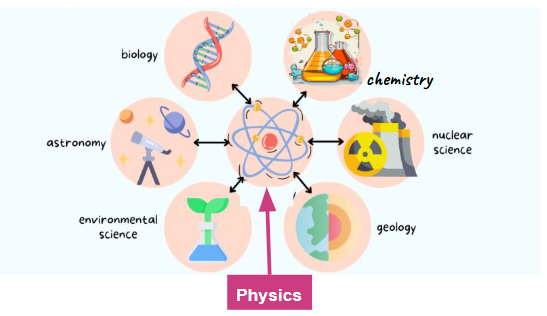
- Physics is the most essential field of science and it has a strong influence on most scientific developments.

-
Both physics and chemistry are concerned with matter and its interaction with energy
-
However, physics looks at this question on a much smaller scale.
-
Physics concerns the movement of physical objects in time, while chemistry concerns the transformation of physical matter from one type to another.
-
Spectroscopy is the study of the interaction between matter and electromagnetic radiation as a function of the wavelength or frequency of the radiation.

Physics can explain the human body like
- the mechanics of human motion
- the energetics of metabolism
- the fluid dynamics of blood flow through vessels
- the mechanisms for speaking and hearing
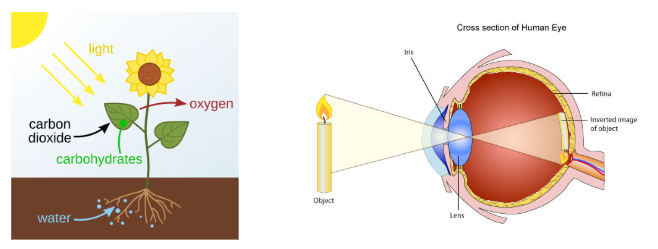
- the optical imaging system we call the eye

-
The Newtonian mechanics tells us how different animals and their body parts move. Physics and biology helps to understand :-

-
Newtonian mechanics tells us that a body is in stable equilibrium under the action of gravity.

-
The physics of fluid flow, like viscosity, equation of continuity and turbulent flow, is very important in understanding the circulation of blood and blood pressure in the multicellular organisms.
-
Soft-bodied animals(such as the sea anemone and the earthworm) that lack a firm utilize Pascal's principle to produce body motion.


-
Sound is a mechanical wave produced by vibrating bodies
-
The vocal cords produce sound when they come together and then vibrate as air passes through them during exhalation of air from the lungs.




-
In photosynthesis, plants use light to convert carbon dioxide and water into organic materials, which are the building blocks of living organisms.
-
Animals have evolved light-sensitive organs, like the eyes.
-
Optical physics is the study of light, includes topics such as microscopes, telescopes, vision, color, pigments, illumination, spectroscopy, and lasers.

- Astrophysics is the study of the physics of heavenly objects, called astronomical objects, like the solar system , stars, interstellar gas and dust ,galaxies, and finally the study of the Universe as a whole.


-
Newton’s law of gravitation is used to describe the motion of the moon around a planet and the motion of the planets around the sun.
-
The knowledge of centripetal force and centrifugal force from our physics knowledge greatly help as to understand what keeps objects in orbit around others.


- Astronomers collect information about the radiation from space objects, they use light to measure distance of astronomical objects.
- Measuring the apparent brightness of an object gives its distance if we know it's true brightness.

- This is known as the inverse square law of apparent brightness.
- A light year is the distance that light travels in one year.

-
Photon is emitted electrons of atoms jump from higher to a lower atomic orbit,
-
Photon is absorbed if electron jumps from lower electron orbit to higher electron orbit
-
The emission and absorption of radiation depends on the characteristics of individual atoms, and helps to measure something about the compositions, temperatures, and motions of stars.


-
The understanding of geological processes demand the understanding of the different concepts of physics like
-
Force
-
Optics
-
Atomic structure
-
Electromagnetic radiation
-
heat and heat flow
-
Electricity and magnetism
-
Stress and strain
-
Waves including sound wave and fluid flow
-
In geology, these physics concepts are used to study the properties of rocks and minerals.

1. How is physics important in chemistry?
A) Physics and chemistry are completely unrelated.
B) Physics provides fundamental laws that help explain the behavior of matter in chemistry.
C) Physics only contributes to chemical engineering, not pure chemistry.
D) Physics is important in chemistry only for studying reactions at very high temperatures.
2. Which physics principle helps to explain the flow of blood in the human body?
A) Laws of electromagnetism
B) Newton's third law of motion
C) Principles of fluid dynamics
D) Laws of thermodynamics
3. What is the role of spectroscopy in physics and chemistry?
A) It is used only for measuring sound waves.
B) It measures the gravitational force between atoms.
C) It is used exclusively in the field of biology.
D) It studies the interaction between matter and electromagnetic radiation.
4. Which of the following uses optical physics in biology?
A) Calculating the force of gravity on different body parts
B) Measuring the rate of blood flow
C) Determining the structure of the eye and the process of vision
D) Predicting chemical reaction outcomes
5. Which physics concept is crucial for explaining the stability of a person standing upright?
A) Center of mass and base of support
B) Electromagnetic interactions in the body
C) Nuclear fusion reactions
D) Thermal expansion of bones
6. What physics concept helps astronomers measure the distance to faraway stars?
A) The laws of electromagnetism
B) The inverse square law of apparent brightness
C) Fluid dynamics principles
D) Newton's first law of motion
7. Which concept is essential for explaining the stability of objects in orbit, such as satellites around Earth?
A) Electromagnetic induction
B) Newton’s law of gravitation and centripetal force
C) Thermodynamics and energy conservation
D) Fluid mechanics and air resistance
8. How does physics contribute to the field of geology?
A) By providing principles for chemical reactions
B) Through the understanding of seismic waves and radioactivity in rocks
C) By predicting weather patterns and climate change
D) By studying living organisms and ecosystems
9. Which branch of physics is most closely associated with studying the properties and behaviors of light in biological systems?
A) Thermodynamics
B) Nuclear physics
C) Optics
D) Quantum mechanics
10. Why is the understanding of atomic and subatomic particles crucial in chemistry?
A) To measure gravitational forces between elements
B) To understand chemical bonding and molecular structure
C) To predict the motion of celestial objects
D) To explain the mechanical properties of materials
Answer
1.B 2. C 3. D 4. C 5. A
6. B 7. B 8. B 9. C 10. B