1.3 Vector addition and Subtraction


-
The addition of scalar quantities is non problematic, it is a simple arithmetic sum.
-
When two vectors are added, you need to take account of their direction as well as their magnitude.
-
The sum of two or more vectors is known as resultant vector.
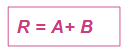
If vectors A and B have a resultant R, this can be represented mathematically
Since vector addition is commutative,
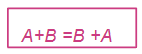
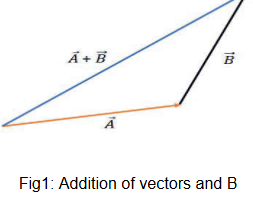


Fig 2: Geometrical subtraction of vector
-
If the sum of two vectors is zero,then one is said to be the negative of the other
-
That is, if A+B = 0, then A = -B
-
The operation of vector subtraction makes use of the definition of the negative of a vector.
-
We define the operation A-B as vector -B added to vector A:
A - B = A + (-B)
Since vector subtraction is not commutative,
A - B ≠ B - A


-
Two vectors can be added geometrically using the tail-to-head method (also called the triangle rule) or tail-to –tail method (the parallelogram rule).
-
Triangle law of vector addition is used to find the sum of two vectors.
Head-to-tail method of vector addition

Fig 3:Head-to-tail method of vector addition

-
The sum of the two vectors is given by the diagonal of the parallelogram.
-
Their resultant vector is represented completely by the diagonal of the parallelogram drawn from the same point.

Fig 4: Parallelogram rule of vector addition

-
This law is used for the addition of more than two vectors.
-
The resultant of all vectors can be obtained by drawing a vector from the tail end of first to the head end of the last vector


Adding and Subtracting Vectors Algebraically (Analytically)
-
Let us now consider a few special cases of addition of vectors
Case 1 : When The two vectors are in the same direction (parallel;𝝱=0)
-
If vectors A and B are parallel, then the magnitude of the resultant vector R is the sum of the magnitudes of the two vectors.
-
Hence, the magnitude of the resultant vector is |R| =|A+B|
-
Since the two vectors are in the same direction, the direction of the resultant vector is in the direction of one of the two vectors.
Case 2: When the two vectors are acting in opposite directions
-
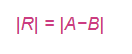
If vectors A and B are anti-parallel (i.e., in opposite direction), then the magnitude of the resultant vector R is the difference of the magnitudes of the two vectors. Hence, the magnitude of the resultant vector is
-
Since the two vectors are in opposite directions with one another, the direction of the resultant vector is in the direction of the larger vector.
Case 3: When the two vectors are perpendicular
-
If vectors A and B are perpendicular to each other, then the magnitude of the resultant vector R is obtained using the Pythagoras theorem.
-
Hence, the magnitude of the resultant vector is R2 =A2 + B2

-
The direction of the resultant vector is obtained using the trigonometric equation:


-
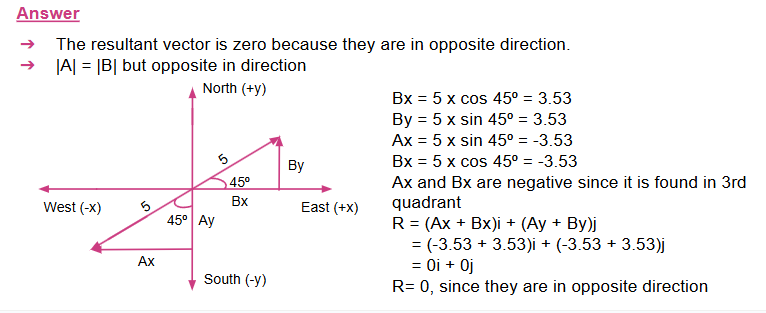
Two vectors A and B have the same magnitude of 5 units and they start from the origin: B points to the North East and A points to the South West exactly opposite to vector B. What would be the magnitude of the resultant vector? Why?
2. If two vectors have equal magnitude, what are the maximum and minimum magnitudes of their sum?

3. If three vectors have unequal magnitudes, can their sum be zero? Explain.

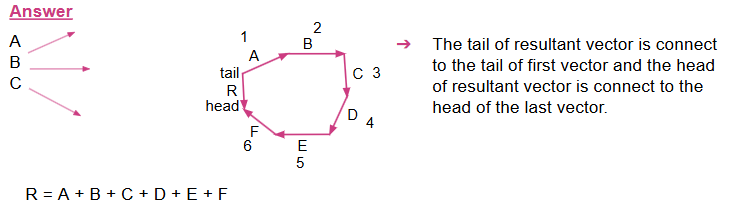
4. Consider six vectors that are added tail-to-head, ending up where they started from. What is the magnitude of the resultant vector?
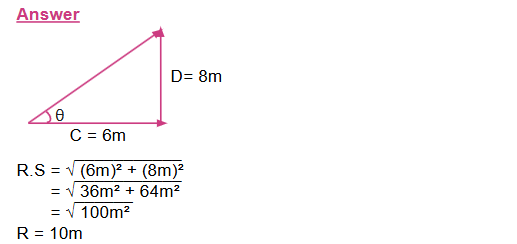
5. Vector C is 6 m in the x-direction. Vector D is 8 m in the y-direction. Use the parallelogram method to work out C + D .